"Emergent Futures in the Weave: On Lucia Kempkes’ To Harvest a Promise Dissolving in Heat" by Anne Daffertshofer
"Emergent Futures in the Weave: On Lucia Kempkes’ To Harvest a Promise Dissolving in Heat" by Anne Daffertshofer
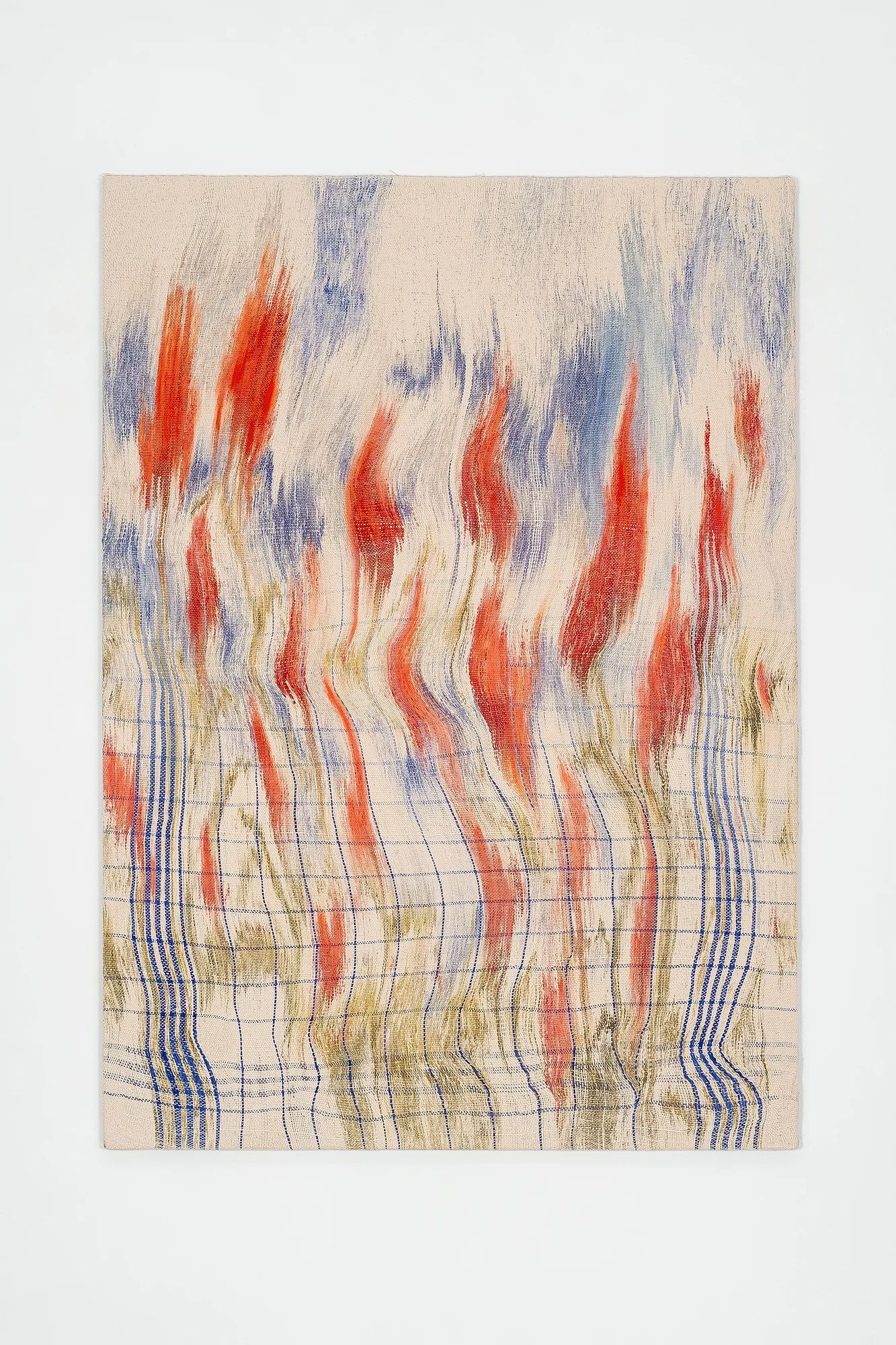
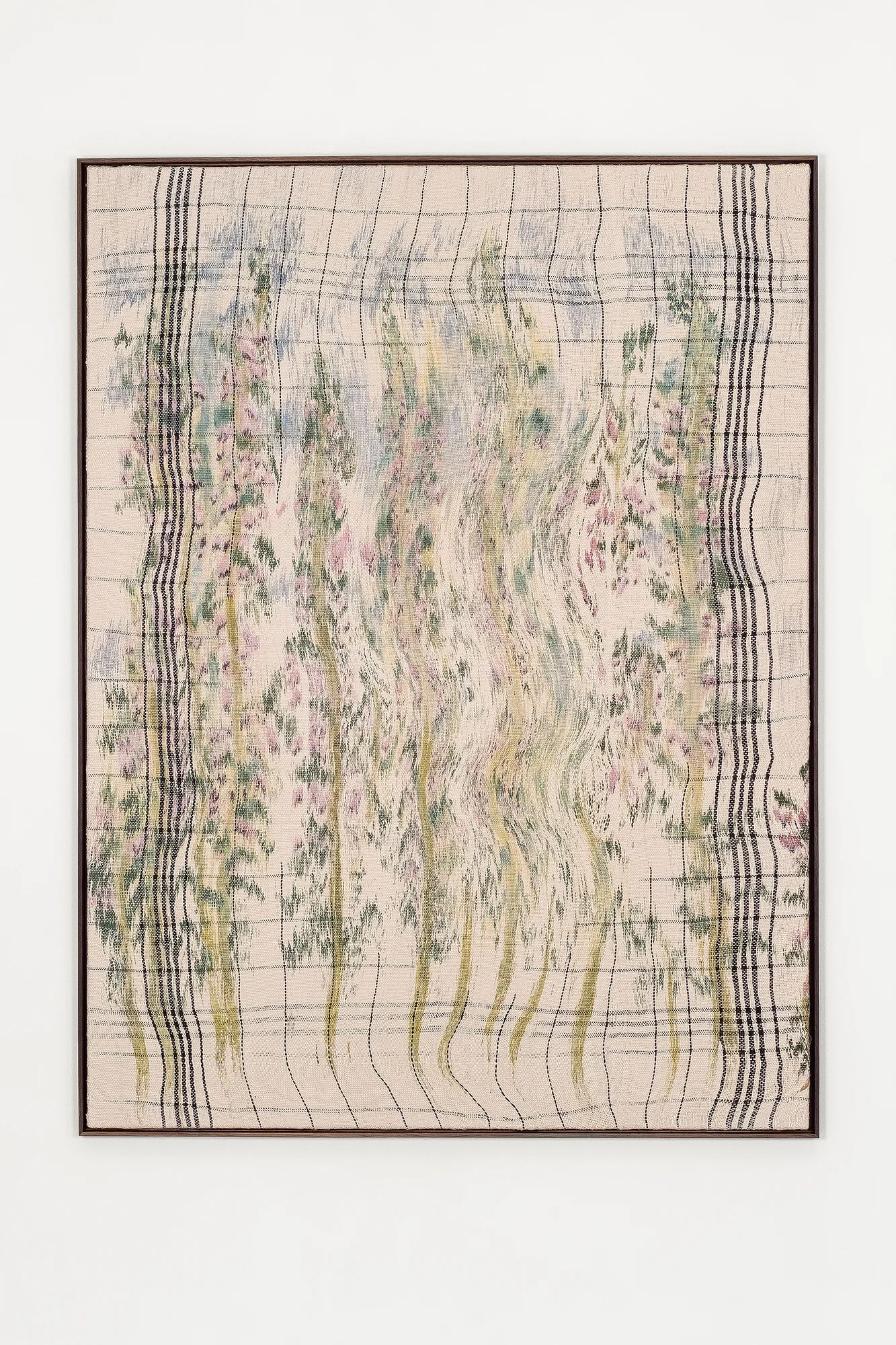
Red, yellow, and lilac flowers are blurred against the checkered pattern idiosyncratic of a tea towel. To Harvest a Promise Dissolving in Heat by Berlin-based artist Lucia Kempkes opens the view on agricultural scenes as if glimpsed through the window of a car at speed, fragmentary and ephemeral. The series is loosely modelled on climate adaptation strategies, inviting speculation about futures shaped by climate changes in Central Europe. While discussions of crops, harvests and future yields may sound like the reserve of agricultural managers, and technocratic policymakers, this body of work instead foregrounds an affective lens, activating a distinctly different register. What might nostalgia for a future past look like? What colours, scents, and summers might those not yet born remember?
A central tension in Lucia Kempkes’ textile works reveals itself in the interplay of subject matter, style, form and medium. What unfolds is a multifaceted intersection of agricultural scenes and their ambiguous meanings in contemporary discourse, amplified by visual references to domesticity through the tea towel. This tension further reverberates in the contrast between the impressionist-like pictorial style and the grid of the tea towel check, whose rigidity is occasionally disrupted as straight lines undulate. On a material level, the grid reappears in the inherent structure of the woven textile, inviting viewers to reflect on how the series’ pictorial elements inform and complicate one another.
Crucially, the depicted landscapes imagine a scenery ever after the implementation of a changed agricultural strategy. The vivid colours suggest a pragmatic optimism – one that renders agricultural climate adaptation strategies beautiful, and refuses both the fatalism of much climate activism and the comforting fiction of an unaffected future perpetuating the past. Tensions between agriculture-as-tradition and the crops Europeans will need are made concrete in the selection: sorghum, okra, amaranth, lupins – species from outside Europe, once treated as marginal, now increasingly valuable for their drought resistance. The changes ahead are both mundane and drastic: they will alter the food we eat, the recipes we pass down, the colours we see from the window. The nostalgic undertone, embedded in the blurriness we recognise from memories, becomes a potent strategy for making an unfamiliar site legible, imbuing it with a longing.
The visual vocabulary draws on deep art historical roots. Wholesome late-summer fields have long occupied a steady place in Western painting since the nineteenth- century rural idyll – happy peasants, bountiful harvests, soft golden hour light. The work participates in that lineage of landscape painting yet also positions itself at the intersection of painting and weaving. Each thread is painted by hand before being embedded into the textile, resulting in a careful interplay of control and chance. This process creates a painterly, at times almost organic visual quality, even as it emerges from the material’s inherent geometric structure.
The pictorial style recalls brushstrokes characteristic of Impressionist gardens and fields, conveying a fleeting, sensorial impression of ephemeral beauty. Yet while Kempkes’ pictorial weaving implicitly references art historical conventions that shape our perception of landscape, it also filters these motifs through a contemporary, or perhaps futuristic lens, simultaneously recreating and unsettling the notion of idealisation. While the ‚ideal’ landscape may often occur as a form of escapism, To Harvest a Promise Dissolving in Heat offers a more complicated vision. By rendering a fundamentally altered world in an aesthetic just familiar enough to evoke nostalgia, Kempkes mobilises a powerful pictorial strategy – one that reconciles supposed boundaries between past and future, painting and weaving, tradition and progressiveness in enigmatic synthesis.
The grid appears not only in the material itself, but also in the checked pattern. It invokes the gendered domestic sphere of tea towels and the often-forgotten histories of those who cooked and wove, grew plants, and tended gardens. Rather than symbolising a retreat into a shrunken sense of domesticity, however, To Harvest a Promise Dissolving in Heat places a seemingly mundane object at centre stage, entangling imagination, openness to change and a visionary outlook. At the same time, the composition might also evoke the way land is parcelled out by use, divided into separate sections, with borders marking ownership echoing the grid. In #3, wavy green stems organically bleed into the grid’s structure. Here, the rudimentary dissolution and replacement of the grid by high-growing, flowering crops not only softens its geometric visual rigidity, but also invites a layered symbolic interpretation. This gesture could allude to international border regimes attempting to regulate crossings of plants, animals and humans. Alternatively, it might invoke the dissonance between the natural world and artificial, human-made boundariesthat are changing and shifting as our environment becomes transformed through the climate crisis.
Across the series, the grid’s authority is interrupted in different ways. In #2, red hues set against pale blue, slightly cloudy passages dissolve the grid, overtaking the upper half of the picture. The red reflects an almost fire-like quality, resonating with the heat referenced in the series’ title – an aspect that feels especially poignant as I write these words in late July 2026. At this moment, wildfires are consuming vast areas in France and Spain, while the Scottish Cairngorms witness the worst fires in living memory: events that eerily foreshadow a future we have been warned about for decades, threatening agriculture, biodiversity and our livelihoods. As decisions today shape the living conditions of tomorrow, questions about power, land, and who gets to design our environment could not be more relevant. Whether a field is given over to regenerative farming, industrial agriculture, or a hyperscale data centre, each decision is laden with conflicting interests and carries far-reaching consequences. By picturing agricultural scenes transformed through conscious decisions to introduce non-native crops, and wrapping this vision in nostalgia and affect, To Harvest a Promise Dissolving in Heat offers a particularly thought-provoking intervention in contemporary discourse.
Meanwhile, nostalgic imagery – fields, domestic interiors and a craving for simpler times – pervades contemporary visual culture, from Netflix’s reboot of ‘Little House on the Prairie’, to YouTube homesteading culture or reactionary ‘trad’ movements. This imagined past looms especially large in current political life where extreme ideologies meet contemporary grievances with the false promise of a simple return to the ways things allegedly used to be. Within this context, fields become associated with the anti-modern: a slower life, homemade things, and a sense of belonging or community are values many mourn. This becomes further reinforced through the subtle visual resemblance to vintage tea towels, adorned with ditsy patterns. However, the distinct distortions here contrast with the apparent innocence of the imagery, introducing a subtle uncanniness which underlines the double-edged play with nostalgia, strengthening the tension at the heart of the series.
To Harvest a Promise Dissolving in Heat hovers on the threshold between memory and anticipation, the domestic and the agricultural, loss and adaptation, yet offers a more critical meditation on that idealised past, highlighting the potency of affect projected onto a future that might never come to be. Here, nostalgia functions as a form of attention rathe than retreat – it is a sustained gaze towards the future embracing the flux that will increasingly define our lives. Ultimately, To Harvest a Promise Dissolving in Heat does not resolve questions about land use or idealised imagery. Instead, its affective approach opens towards the blurry contours of emergent futures.